Every house and apartment in Japan has a genkan (玄関). It’s the entranceway located just inside the front door. Before entering the home, shoes are removed in the genkan; when leaving, they are put back on before stepping outside. It is such an ordinary part of daily life that most Japanese people rarely give it a second thought.
The concept of the genkan is deeply rooted in Japanese culture and has been a feature of Japanese homes for centuries, representing the threshold between the chaotic outside world and the peace and privacy of the home. It also marks the boundary between what is considered “clean” inside, and the “unclean” world beyond.
The genkan is an unavoidable part of Japanese life. Yet it has also become the setting for a little-known and deeply tragic phenomenon.
In English, we sometimes say that someone has “worked themselves to death.” Usually, we mean it figuratively—that they have worked so hard it has taken an obvious physical, emotional, or relational toll. Japanese has a similar term, karōshi (過労死), but here the phrase is used in a literal sense. It describes people who literally die as a direct result of overwork. Karōshi is typically the result of prolonged stress, chronic sleep deprivation, and excessive overtime, sometimes ending in a fatal heart attack or stroke. Strangely, many of these deaths occur in the victim’s own genkan, just inside the front door.
Every one of these deaths is an avoidable tragedy, but they are also a symptom of a deeper problem that has become synonymous with modern Japan: busyness. It could well be the greatest challenge to reaching much of the Japanese population with the gospel message, but I am beginning to feel as though it could be our greatest opportunity also.
It is a challenge because this culture of busyness often allows little or no room for the kind of relationship and conversation that we typically rely on to evangelize and disciple people. Time is a rare commodity for many groups of Japanese society, and so even if a person expresses an interest in spiritual matters, finding the time to pursue it can be difficult.
Many missional initiatives look for creative ways to overcome the barrier of busyness by finding an interest or activity, such as sport or cultural activities. The idea is that by sharing an activity we both enjoy, we can build a relationship that may eventually open opportunities to talk about matters of faith. When it was discovered that I was keen on skateboarding in my youth—and that I still ride—it was often suggested that I should have a “skateboarding ministry”.
I can certainly see the wisdom in building relationships with people who share similar interests, and yet something about this approach as a ‘ministry’ never sat well with me. I came to realise that without very intentional effort, it was all too easy for me to begin calibrating my life and ministry around the rhythm and pace of Japanese culture. Over time I became concerned that, in our desire to reach a busy people, we could unintentionally adopt their approach to life and work. Instead of offering something fresh and distinct, we simply become just as busy as everyone else.
The question slowly shifted in my mind from, “How do I gain access to busy people?” to, “How has God called me to live life as a witness to Him?”
About five years ago, while waiting to come to Japan, we both had a strong sense that the Lord was giving us a “ministry of rest.” It was a phrase I had never heard before, and at the time I had little idea what it meant. When I thought of mission work, words like tireless, hardworking, innovative, and industrious came to mind. Rest was not something I would have immediately associated with mission, especially when the urgency of the gospel is rightly emphasised.
Rather than trying to work it all out, I simply trusted that if this was from the Lord, He would reveal it in His own time. Having now spent a few years in Japan, I am beginning to see that rest is about more than self-preservation. It is a way of living that points to God. When we model a healthy rhythm of rest, I believe it will be noticed—and it may even be attractive.
I certainly don’t have the full picture, nor do I believe we have fully walked out what the Lord spoke to us. But it is a good time to pause and consider why rest may be a vital part of mission in Japan right now.
This is not a new problem. The Jews in the Old Testament were also tempted to adopt the practices of the surrounding peoples. Nehemiah, for example, had to address the buying and selling that was taking place on the Sabbath (Nehemiah 13:15–22), despite God’s clear command to keep the Sabbath holy. God had called Israel to be “a kingdom of priests and a holy nation” (Exodus 19:6)—a people who would reflect something of His character and show the nations another way to live.
The Apostle Peter later applies this same language to followers of Jesus (1 Peter 2:9). As a kingdom of priests, we are called to model a way of life that reflects God and gives the world a glimpse of the kingdom of God. I believe that the way we model rest could—and perhaps should—become a big part of how we reach Japanese people with the good news of Jesus. But to understand how rest could become part of our mission, it is worth taking a step back and asking the question: What does the Bible actually mean by rest?
As early as the second chapter of Genesis, the Bible introduces the concept of rest in the form of the Sabbath, and it becomes a theme that runs through the entire biblical narrative. Rest is modeled by God Himself, embedded in the law and woven into the weekly and annual rhythms of God’s people. It was important enough to be included among the Ten Commandments, alongside commands such as not to steal, kill, or covet. The Bible takes rest seriously, both highlighting its blessing and warning of the consequences of neglecting it.
Although the word ‘rest’ appears nearly 300 times in the Old Testament, it is translated from three different Hebrew words. Each speaks of a different aspect of rest, and together they give us a fuller picture of what biblical rest is and why it matters.
Shavat – Ceasing
Stopping the activity we are engaged in. This is the root of Sabbath and is seen most clearly in God’s cessation from His creative work and in the Sabbath command.
Nuach – Resting in security
Being settled in a place where we are no longer threatened or wandering. Joshua 21:44 is a great example: God gave Israel rest (nuach) on every side.
Menuchah – Deep rest and tranquillity
Not merely the absence of activity or danger, but an inner state of settled peace. Psalm 23’s ‘waters of rest’ (mei menuchot) is a beautiful example.
Together, these three words give us a fuller picture of biblical rest:
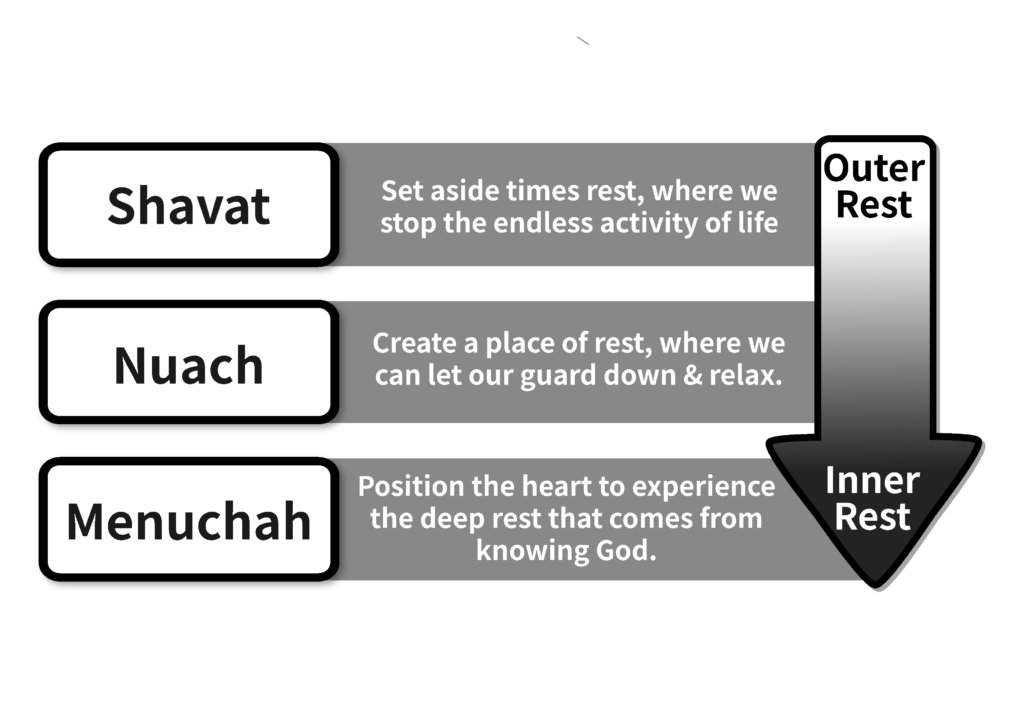
As I looked into these words, it became clear to me that the language of the Bible does not treat rest as a single, flat concept as we often do. It is meaningful, layered, and reveals different dimensions of rest. It includes the simple act of stopping, but also speaks of finding a place where we no longer feel threatened or need to remain on guard. It even points beyond the absence of activity towards a deeper rest and peace that comes from knowing God. This is the still water our souls so desperately need in the chaos of modern life.
In the following three blog posts, I want to look more closely at each of these dimensions of rest: why they are important, what they offer us, and how they have the potential to transform our missional work in Japan and beyond. We all recognize the benefits of a healthy rhythm of rest, even if we don’t always pursue it. But we don’t often think of rest as an opportunity to represent the kingdom of God to those around us. I believe it can be deeply missional.
“I am the gate; whoever enters through me will be saved. They will come in and go out, and find pasture” (John 10:9).
In a sense, Jesus offers us a spiritual genkan—the threshold through which we pass from the chaos and uncleanness of the world into a place of safety, provision, and rest. When we cross that threshold, we discover that true rest is found in Him. Yet the author of Hebrews tells us to “make every effort to enter that rest” (Hebrews 4:11). Rest is not our default. It is not laziness or disengagement, but a deliberate act of faith and obedience. Choosing God’s rhythm of rest over the pressure to remain constantly busy will likely require us to make some significant changes in the way we think about our time, our work, and even our ministry.
In a culture where people are increasingly exhausted by the demands of life, our willingness to live differently may speak more loudly than we realize. The reality of people working themselves to death reminds us that the world has no shortage of activity, but it offers very little true rest. Those of us living and serving in Japan have an opportunity to model something different.
This may require some difficult decisions and significant paradigm shifts. But perhaps our quiet, still position of rest will become one of the things that speaks loudest in a world that shows no sign of slowing down.
Leave a Reply